Modern Activation Functions
The modern activation family - ELU, SELU, GELU, Swish/SiLU, Softplus, and Maxout - and why they exist.
Two things wrong with ReLU, one of which nobody mentions
The one everybody mentions:
A dead ReLU is not a slow learner. It is a block of parameters that has been removed from your network while you continue to pay for its memory and its arithmetic.
The one nobody mentions:
Every framework picks one anyway, usually 0, and nothing catches fire. But the function being differentiated is not differentiable at the one point every freshly initialised neuron starts out near, and the entire training procedure is built on differentiating it.
Six functions on this page. Every one of them is fixing one or both of those two things.
Before this page - 3 pages3
Activation Functions
ReLU, the dying-neuron failure, and the slope table this page's slope table is built to sit besideThe Single Neuron
z, and e as a fixed number, which every curve on this page containsLayers and the Forward Pass
the rain network, which is the network all six of these get compared inside
The same two panels as the previous page, drawing the six curves this page is about, with ReLU left in for reference. Drag the probe into the negative half and stay there, because the entire difference between these six functions is on the left-hand side.
 0:14
0:14What this animation shows
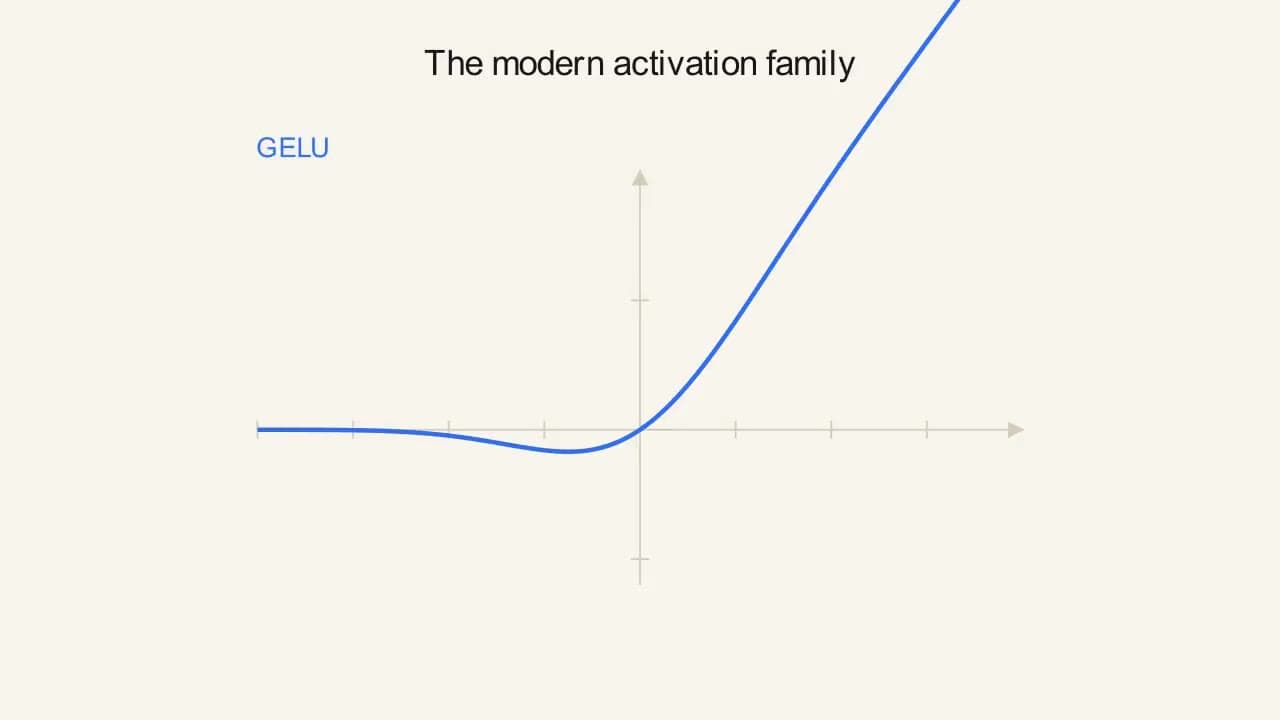
GELU, SiLU (Swish), and ELU each draw themselves in turn on a shared set of axes, one smooth curve at a time in its own color. Compared with the sharper classic activations, these modern curves are visibly smoother through zero and dip slightly negative before rising. This previews the modern activation family the page covers and why each one exists.
f(x) - value of each activation
slope (derivative) of each activation
Softmax isn't shown here - it doesn't operate on one number at a time the way these do. It gets its own page: Softmax for Multi-Class Output.
GELU and SiLU both go negative for small negative inputs, and then, as the input gets more negative, they come back up toward zero. Before you drag the probe: how far down does each one get, and roughly where?
Commit to a guess, then open this
GELU bottoms out at -0.16997, at about x = -0.752. SiLU bottoms out at -0.27846, at about x = -1.278.
Past those points both curves turn around and climb back toward zero, which means the output goes down and then up. That property has a name, non-monotonic, and it is an unusual thing for an activation to have.
ELU and SELU do not do this. They slide toward a floor and stay there, so they only ever go one direction. Drag the probe to -3.00 and compare: ELU reads -0.950213 and is still going down, while GELU reads -0.004050 and has almost finished coming back.
And the honest part, which the rest of this page will repeat: the dip measurably helps, and nobody has a fully satisfying theoretical account of why.
Every function on this page is a smooth gate: instead of making a hard yes-or-no decision about a value, it keeps a fraction of it, and the fraction moves continuously with the input. That buys two things ReLU cannot give. There is no corner, so the slope always has a single answer, including at exactly zero. And there is no exactly-flat region, so a neuron sitting in negative territory still receives a non-zero correction and can climb back out. The six differ only in how the gate opens, and every one of those differences lives on the negative side of the axis.
The dimmer instead of the switch
A light switch has two positions and, at the exact instant of the click, no defined state at all. That is ReLU, corner included. A dimmer passes a fraction of the current, the fraction moves smoothly, and there is no click and no position at which the question "how much is getting through" has no answer. That is GELU. And a dimmer that will not go fully off, so the bulb always glows faintly however far down you turn it, is Softplus, which is both why nothing can die and why you never get a genuinely dark room.
Where it breaks downa dimmer only ever reduces. GELU and SiLU dip below zero and come back, which no dimmer does, and that dip is the part nobody can fully explain.
WordsWhat all six have in common, and what each one isThe hard corner and the dead half, then ELU, SELU, GELU, SiLU, Softplus and Maxout described one at a time.Rung 01
Every function on this page is trying to fix the same two things about ReLU: its hard corner at zero, and its dead flat negative half.
The corner matters because ReLU's slope jumps from 0 to 1 with nothing in between. Approach x = 0from the left and the slope is 0; approach from the right and it is 1; so there is no single answer to "what is the slope at exactly zero" (the technical phrase is that the function is not differentiable there). In practice frameworks just pick one, usually 0, and nothing catches fire, but a smooth curve avoids the question entirely and gives the training procedure a gentler surface to work on.
The flat half matters for the reason page 4 spelled out: exactly-zero slope means exactly-zero gradient means a parameter that cannot move.
Where these functions differ from Leaky ReLU and PReLU is that they do not fix the flat half with another straight line. They curve. All four of ELU, SELU, GELU and SiLU allow a negative output where ReLU gives a flat zero, but they get there in two genuinely different ways, and the difference is worth having straight before the individual sections.
ELU and SELU slide down to a floor and stay there. As the input goes further and further negative, the output keeps decreasing, more and more slowly, and settles just above a fixed floor: -alpha for ELU, which is -1 at the usual setting, and about -1.7581 for SELU. They only ever go one way, which is what monotonic means. There is no dip and no turning point.
GELU and SiLU do something stranger. Go negative and the output drops to a small negative minimum, then climbs back toward zero as the input gets more negative still. GELU bottoms out at -0.16997 around x = -0.75; SiLU bottoms out at -0.27846 around x = -1.28. The output goes down, then up, so these two are non-monotonic, which is an unusual property for an activation to have. That dip turns out to help, and nobody has a fully satisfying theoretical account of why. This page will say what each one does and what it is measurably good at, and will not pretend the field has more certainty than it does.
ELU
ELU stands for Exponential Linear Unit. For positive inputs it is exactly ReLU: hand the number back unchanged. For negative inputs it follows a curve that starts at 0 and flattens out at a floor of -alpha no matter how negative the input gets. So it never dies (the slope is never zero) and it never runs away (the output cannot go below -alpha), which Leaky ReLU and PReLU both can.
Leaky ReLU's negative branch is still a straight line heading to −∞ for very negative inputs. ELU instead curves and flattens smoothly toward −α as x gets very negative, which keeps a network's average activation closer to zero (like tanh) while its positive side stays identical to ReLU.
SELU
SELU stands for Scaled Exponential Linear Unit, and it is ELU with two very specific numbers glued to it. The idea is unusual: instead of choosing an activation and then adding a separate normalization layer to keep the numbers in each layer well behaved, pick the activation's constants so that the normalization happens automatically. "Well behaved" here means each layer's outputs have mean 0 (they average out to zero rather than drifting up or down) and variance 1 (they are spread out by a consistent amount, neither collapsing to nothing nor exploding). Those two constants are not tuned or approximate. They are the exact solution of the equations that force that property.
SELU uses α≈1.6733 and λ≈1.0507, chosen so that if a layer's inputs already have mean 0 and variance 1, its outputs land back at mean 0 and variance 1 too, layer after layer. The activation function does its own normalizing, without needing a separate technique like Batch Normalization.
GELU
GELU stands for Gaussian Error Linear Unit, and it needs one piece of vocabulary first.
Phi(x)is a gate that behaves a lot like sigmoid: it is always between 0 and 1, and it climbs smoothly from "mostly off" to "mostly on" as x increases, so it looks a great deal like sigmoid without being sigmoid. That is the whole working picture, and it is enough to use GELU correctly.
For the curious, Phi(x) has a formal name too: the standard normal cumulative distribution function, which is a long name for a simple question about the "bell curve" shape that shows up whenever a lot of independent random effects average out (heights in a population, measurement error, and so on): if you draw one random number from that standard bell curve, what is the chance it comes out below x? The bell curve is centred at 0, so Phi(0) = 0.5 exactly, half the curve is below zero. Phi(1.4) = 0.919243, meaning 91.9% of the bell curve sits below 1.4. Phi(-0.7) = 0.241964, meaning only 24.2% sits below -0.7. None of this changes how GELU behaves - it is background for readers who want to know where the curve comes from, not a requirement for using it.
GELU is then x multiplied by that number: GELU(x) = x * Phi(x). Where ReLU makes a hard yes-or-no decision about whether to keep a value, GELU keeps a fraction of it, and the fraction is how confidently positive the input is. At x = 1.4 you keep 91.9% of it. At x = -0.7you keep 24.2% of it, and since the value itself is negative, you get a small negative output instead of ReLU's hard zero. At x = 0 you keep exactly half of zero, which is zero, so the two functions still agree at the origin.
GELU is the default activation in most modern transformer architectures (BERT, GPT-style models), though those are beyond this module's scope. Notice it is non-monotonic: it dips slightly negative for small negative x, unlike ReLU's hard 0, before rejoining x for large positive x.
Swish / SiLU
SiLU stands for Sigmoid Linear Unit, and Swish is the same function with an extra tunable knob. It is the same idea as GELU with a cheaper gate: instead of Phi(x), multiply x by sigmoid(x). Since sigmoid also runs from 0 to 1 and also climbs smoothly, it does almost the same job for a fraction of the compute, which is why the two functions look nearly identical when plotted. Swish(x) = x * sigmoid(beta * x) adds a beta that controls how sharply the gate opens; setting beta = 1 gives SiLU, and that is what nearly everyone uses.
Like GELU, it dips slightly below zero for small negative inputs before flattening out, which turns out to help gradient flow in deep networks.
Softplus
Softplus is the answer to "what if ReLU's corner were rounded off". It rises smoothly from just above 0, bends through ln(2) = 0.693147 at the origin, and for large positive inputs becomes indistinguishable from x itself. It never returns exactly zero for any input, so no neuron can ever die. The catch is in that same sentence: it never returns exactly zero, so a neuron that ought to be silent still leaks a little signal, and you lose the genuine sparsity (large blocks of exact zeros) that makes ReLU networks cheap.
Maxout
Maxout is the odd one out on this page, and the odd one out in the whole module. Everything else here is a fixed curve applied to a number that a neuron already computed. Maxout replaces the curve entirely: run k separate weighted sums on the same inputs and keep whichever came out largest. There is no curve to apply, because the shape of the resulting function is whatever the learned weights make it - at the cost of k times the parameters for that layer.
NumbersEvery one of them, evaluatedSix functions worked at fixed points, one Maxout unit built from the rain network, and the whole family run through it.Rung 02
The exact shape depends entirely on the learned weights, which is the whole point.
One maxout unit, built from the rain network
Here is Maxout built out of the small rain network's own two hidden neurons, which makes the parameter cost concrete. Take h1 and h2 exactly as they are, and instead of activating each one separately and passing both forward, keep only the larger.
Six parameters in, one number out. The same six parameters used as two ordinary neurons give you two numbers out. That is the "k times the parameters" cost, counted: a Maxout layer of width m with k = 2 needs as many weights as an ordinary layer of width 2m.
What you buy is that the unit's shape is not fixed in advance. On one side of the line 2.50 * x1 + 1.50 * x2 = 0.80 it behaves like one linear function, on the other side like a different one, and where that boundary sits is learned. ReLU is the special case where piece B is pinned to the constant 0 and never learns.
h1(x) and h2(x), dashed; the bold envelope is h(x)=max(h1,h2), what the neuron actually outputs.
The bold envelope is what the neuron outputs, and the kink in it is where the two pieces swap over. That kink's position is learned, which is the whole of Maxout.
The modern family, one network
Same comparison as the previous page, same network, same input, so the two tables can be read side by side. Inputs x1 = 0.80, x2 = 0.60; hidden pre-activations z1 = 1.40 and z2 = -0.70; output weights v1 = +1.20 blue, v2 = -0.80 orange, bo = +0.30.
The arithmetic behind two of those rows, written out, since the rest follow the same pattern:
Three things fall out of the table.
GELU lands almost exactly where ReLU lands. 0.8787 against 0.8787, agreeing to four decimals by coincidence of this particular input, but the near-agreement is not coincidence: GELU is a smoothed ReLU and on a positive-leaning input the two barely differ. This is the honest picture of the modern family. They are refinements, not revolutions.
SELU's output is the outlier, and that is expected. It multiplies everything by lambda = 1.0507 and pushes the negative branch down as far as -0.8851, so its final probability is 0.9412, the highest on the page. That is what the scaling is for. It also means SELU is not a drop-in swap; changing to SELU changes the scale of everything downstream.
Softplus is the only row with a positive a2. 0.4032, not negative. Softplus never outputs a negative number, so like sigmoid it is not zero-centred, and the zero-centering complaint from the previous page applies to it too.
PictureWhere each one bottoms outFour different negative-side behaviours, read off the probe one curve at a time.Rung 03
Everything separating these six is on the left of the vertical axis. Probe the right-hand side and ELU, SELU minus its scaling, GELU and SiLU are all converging on the same straight line that ReLU already was. So: probe left, and read four different behaviours.
ELU heads for -1.0000 and stops. At -3 it is at -0.950213, at -4 it is at -0.981684, which is 98.2% of the way to its floor. It never crosses it, and it never turns round.
SELU is the same shape stretched. Its floor is -1.758099, and at -4 it reads -1.725899, which is 98.2% of the way to its floor, the identical fraction, because SELU is ELU scaled by two constants and scaling does not change where a curve sits along its own journey.
GELU dips and returns. The lowest it ever gets is -0.16997, at about -0.752, and by -3 it is back to -0.004050, which is visually on the axis.
SiLU dips deeper and returns more slowly. Its minimum is -0.27846 at about -1.278, and at -3 it is still at -0.142278, a good deal further from zero than GELU is at the same point.
Softplus never goes below zero at all. At -0.70 it reads 0.403186 and at -4 it reads about 0.018. It approaches the axis and never touches it, which is the property that makes it immortal and non-sparse in the same breath.
Now the bottom panel, and one entry in it is worth stopping on before rung 4 gets to it: probe 1.40 and read GELU's slope of 1.129. No curve on the previous page ever exceeded 1.
EquationThe formulas, the slopes, and SELU's two constantsThe slope table at the same two points page 4 used, plus the fixed-point check behind alpha and lambda.Rung 04
A common fast approximation to GELU, used in real code (BERT, GPT-2):
This is a fast approximation to the true erf-based formula above, not an alternate definition - some frameworks default to it, some to the exact version.
Two entries in that table are worth stopping on.
GELU's slope at 1.40 is 1.1289, greater than 1. No function on the previous page ever exceeded a slope of 1. GELU's does, over a band of positive inputs, because it is catching up to x from below as Phi climbs toward 1. A slope above 1 slightly amplifies the training signal passing through rather than shrinking it, which is the opposite of the vanishing-gradient problem.
Softplus's slope is exactly sigmoid. 0.8022 at z = 1.40 and 0.3318 at z = -0.70 are precisely sigmoid(1.40) and sigmoid(-0.70), the same two values in the sigmoid row of the previous page's activation table. That is not a numerical accident: the derivative of ln(1 + e^x) is e^x / (1 + e^x), which is exactly sigmoid(x). It is the same curve you met on the previous page.
Verifying SELU's central claim
The page claims SELU's two constants are chosen so a layer's outputs come back to mean 0 and variance 1. That is checkable, so here it is checked.
The condition the constants have to satisfy is: if the numbers going into SELU are spread out like a standard bell curve (mean 0, variance 1), then the numbers coming out must have mean 0 and variance 1 as well. Computing those two quantities for alpha = 1.6732632 and lambda = 1.0507010 gives:
Averaging to 0, with an average squared size of 1, is exactly what "mean 0 and variance 1" means. Both land on the target to six decimal places, which is what "solved the fixed-point equations" means in practice. Those two conditions are two equations in two unknowns, and alpha and lambda are their solution. Nothing was tuned.
General caseThe strings attached, and what to actually useWhy SELU is a package deal rather than a swap, and the honest six-line recommendation.Rung 05
SELU is a package deal, not an activation you can drop into an existing network. It delivers the behaviour above only if the rest of the network is set up its way, and that means two specific things: a particular way of choosing the starting weights, and a particular variant of one common training trick. Use the ordinary version of either and the guarantee is gone, leaving you with an oddly-scaled ELU and none of the promised self-normalization. For completeness, the two conditions are initialization from a normal distribution with variance 1/n, where n is the number of inputs to the layer, a scheme usually called LeCun normal, and alpha dropout rather than ordinary dropout. Both are covered properly on the initialization and training-time-regularization pages. You do not need either term yet. You only need to know that SELU comes with strings attached.
Same random input, 5layers deep. Both branches get a freshly random weight matrix and bias every layer - the SELU branch's weights are scaled the way SELU's proof assumes (variance ≈ 1/width, at init scale 1.00); the right-hand branch's weights are drawn 50% "too hot," a common near-miss on proper scaling, and no activation follows them at all.
SELU
Plain linear (no activation)
Watch the SELU bars: they stay close to the L0 (input) height, layer after layer, because the fixed point of the SELU map sits near mean≈0, var≈1. The plain-linear bars keep growing, because nothing pulls a linear transform's output back toward any particular scale.
The SELU bars hold near the L0 height layer after layer; drag the init-scale slider off 1.0 and watch that stop being true, which is this rung's point made visible.
Which of these should you use
The honest version, which is shorter than the length of this page implies.
GELU if you are building or fine-tuning a transformer, because that is what the architecture was tuned around and matching it removes a variable.
SiLU / Swish as a general-purpose smooth alternative to ReLU. It is cheaper than exact GELU and behaves almost identically.
ELU if you specifically want the bounded negative branch, most often in smaller networks without batch normalization.
SELU only if you commit to the whole package: LeCun normal initialization, alpha dropout, and a plain fully-connected stack. Outside those conditions it is just an oddly-scaled ELU.
Softplus rarely as a hidden activation. Its main modern use is on an output where the answer must be positive, such as predicting a variance or a count, which the output-activations page picks up.
Maxoutrarely, because doubling a layer's parameters is a steep price and batch normalization solved most of what it was proposed for.
And the thing worth saying plainly: on most ordinary tasks the gap between ReLU, GELU and SiLU is small, often smaller than the run-to-run variation from a different random seed. The table above moved the final probability from 0.8622 to 0.9412 across the whole family, which looks large, but that is one hand-set network on one input with no training to compensate. A trained network adjusts its weights around whichever activation it was given. Activation choice is worth getting sensible and rarely worth agonising over.
Why this and not that
Why not just always use GELU, if the big models do?
Because on most ordinary tasks the difference from ReLU is smaller than the difference between two random seeds, and GELU costs more arithmetic per neuron. If you are building or fine-tuning a transformer, matching what the architecture was tuned around removes a variable and is worth it. Outside that, it is a preference.
Why is SELU not a drop-in?
Its whole guarantee is conditional on the weights being initialised with variance 1/n and on alpha dropout rather than ordinary dropout. Change either and you have an ELU scaled by 1.0507 and none of the self-normalization. The page says this in rung 5 because a beginner who swaps SELU in and keeps He initialization gets nothing and has no way to know.
Why does the dip in GELU and SiLU help?
There is no satisfying answer. It measurably helps on standard benchmarks and the accounts offered for why are post-hoc. Saying so is more useful than repeating one of them as though it were settled.
If Softplus can never die, why is it not the default?
Because it can never be exactly zero either. ReLU networks are cheap partly because large blocks of activations are exact zeros and can be skipped. Softplus leaks a small positive number out of every silent neuron, so nothing is skippable, and its output is not zero-centred, which is the previous page's complaint applied again.
Why does Maxout cost double?
Because k = 2 means two full sets of weights and biases per unit, and only one number comes out. Six parameters for one output where two ordinary neurons give you two outputs for the same six.
Is ReLU's non-differentiable-corner problem actually solved by these?
For ELU, SELU, GELU, SiLU and Softplus, yes: all five are smooth at zero, so the question always has an answer. Maxout is not; it has a corner exactly where its two pieces cross. Maxout is fixing the other problem.
- ELU, SELU
- Exponential Linear Unit, and Scaled Exponential Linear Unit. Both names are literal descriptions of the formula.
- GELU
- Gaussian Error Linear Unit. The "error" is the error function erf, the piece of maths Phi is built from, and it is called the error function because it came out of nineteenth-century astronomy's theory of observational error, the study of how measurements scatter around a true value. Nothing about GELU is wrong or erroneous; the word is a fossil of where the maths came from.
- SiLU
- Sigmoid Linear Unit. Also literal: a sigmoid times a linear term.
- Swish
- named by its authors at Google Brain, who found the function by automated search over candidate formulas rather than by deriving it. The name has no meaning; it was chosen because it sounded like a smooth thing.
- Softplus
- "plus" is the positive-part function, sometimes written x+, which is exactly ReLU. "Soft" means a smoothed version of a hard operation. That prefix is a convention worth holding onto: softmax on the last page of this module is the same trick applied to a different hard operation.
- Maxout
- the unit outputs a max, so the name is the operation.
- monotonic
- from Greek, "one turn". A monotonic function only ever moves one way.
- Phi
- the standard notation for the normal distribution's cumulative function, and lower-case phi for its density. Inherited from statistics unchanged.
- self-normalizing
- the activation performs the normalization itself rather than needing a separate layer to do it.
- What is happening
- The constants solve a fixed-point equation that assumes weights drawn with variance
1/n. Change the variance and the fixed point is somewhere else. - Fix
- Take the whole package or none of it: LeCun normal initialization and alpha dropout, or a different activation.
- Watch for
- With the init scale at 1.0 the SELU bars hold near the L0 height for all five layers. At 2.0 they climb steadily, which is the guarantee failing in the only way it can fail, quietly.
- What is happening
- True of all five curves on the previous page, false here.
- Fix
- Read the slope panel rather than assuming it. GELU is above 1 across a band of positive inputs, because it is still catching up to
xfrom below asPhiclimbs toward 1. - Watch for
- Probe 1.40: GELU's slope reads
1.129against ReLU's1.000.
- What is happening
- Two genuinely different behaviours get flattened into "the modern ones go a bit negative".
- Fix
- Sort them into the two groups and keep them sorted: ELU and SELU are monotonic and head for a floor; GELU and SiLU dip and come back.
- Watch for
- Probe -3.00. ELU reads
-0.950213and SELU-1.670569, both still descending toward their floors. GELU reads-0.004050, essentially back at zero, and SiLU-0.142278, on its way back. At -3 the gap between the two groups is a factor of over two hundred.
- What is happening
k = 2means two complete weight-and-bias sets per unit, producing one number. The two pieces here are the rain network's own two hidden neurons, taken as a one-input slice withx2 = 0so they fit this widget - which is why the numbers are not rung 2's 1.400000.- Fix
- Budget for it, or take batch normalization instead, which solved most of what Maxout was proposed for at a fraction of the parameter cost.
- Watch for
- At the probe, piece 1 reads
0.200000and piece 2 reads-1.000000, and the envelope takes the larger. Two pieces went in; one number came out. As two ordinary neurons the identical parameters would have produced two.
- 01Find, to the nearest probe step, where GELU's slope first goes above 1.
Hint
It is on the positive side and it is closer to zero than you would guess.Answer
Between 0.75 and 0.80. At 0.75 the slope reads
0.999and at 0.80 it reads1.020. From there it stays above 1 for a band of positive inputs before settling back toward 1 as GELU converges onx. - 02Find SiLU's minimum to within one probe step, and read its value.
Hint
Go left, watch the value stop falling, and note where it turns.Answer
The turn is at about
x = -1.278, so probe -1.30 or -1.25, and the value at the bottom is-0.27846. That is deeper than GELU's minimum of-0.16997, which sits at about -0.752, and the two different depths are the visible difference between asigmoidgate and aPhigate. - 03Confirm that Softplus's slope is exactly sigmoid, at two points, without taking anyone's word for it.
Hint
The two points are the ones the rain network produced, and the answers are already printed on the previous page.Answer
At probe 1.40 Softplus's slope reads
0.802, which issigmoid(1.40) = 0.802184. At probe -0.70 it reads0.332, which issigmoid(-0.70) = 0.331812. Both match the sigmoid row of the previous page's activation-value table, because the derivative ofln(1 + e^x)ise^x / (1 + e^x), which is sigmoid exactly. - 04ELU's floor is -1.0000 and SELU's is -1.7581. Probe x = -4 and work out what fraction of the way to its own floor each one has travelled.
Hint
Divide the reading by the floor.Answer
ELU reads
-0.981684, which is0.981684of -1.0000. SELU reads-1.725899, which is0.981684of -1.758099. The identical fraction, to six decimals, because SELU is ELU multiplied by two constants and multiplying a curve by a constant does not change where it sits along its own approach. That single coincidence is the cleanest evidence that SELU is not a new shape, only a rescaled one. - 05Hardest. On the self-normalizing figure, regenerate the random input five times with the init scale at 1.0 and note whether the SELU bars ever drift. Then set the init scale to 2.0 and regenerate five more times.
Hint
Compare each run's L5 bar against its own L0 bar, not against the other branch.Answer
At scale 1.0 the SELU bars hold near the L0 height across every seed, because the fixed point of the SELU map sits at mean 0 and variance 1 and the weights were drawn with the variance that fixed point assumes. At scale 2.0 they climb, every seed, because the fixed point has moved and the activation is no longer pulling the layer back to where it started. Nothing about the activation changed between the two runs. Only the initialization did, which is rung 5's "package deal" demonstrated rather than asserted.
- BERT and GPT-2GELU is the activation inside every transformer block of both, and it is there for an empirical reason rather than a theoretical one: the authors tried it against ReLU, it trained slightly better, and it stuck.
- YOLO object detectorsSiLU is what runs inside most of them, chosen because it behaves almost identically to GELU for a fraction of the arithmetic, which matters when the model has to keep up with a camera.
ReLU slams the door. This family leaves it ajar.
ELU and SELU push the door to a stop and hold it there. GELU and SiLU let it swing past the frame and drift back. Softplus never lets it shut at all, which is the feature and the bill in the same sentence.
Every number on this page and the last one has been a forward number: evidence in, answer out. Not one of them has been compared against a correct answer. The rain network said 86.4%, then 91.6%, then 94.1% depending on which curve you picked, and nothing anywhere in this module so far has said which of those was any good, because nothing has yet said what it rained.
The next page is the one number that says so. And it turns out that choosing that number badly can hide a completely broken network behind a curve that looks, from a distance, exactly like convergence.